
Article
The AI Copilot for Finance: Where Assistance Should End and Autonomous Action Should Begin
This blog explains why finance AI programs stall despite broad adoption (59% of finance functions use AI, but only 7% report high or very high impact): the constraint is deciding how much authority to delegate, not model capability. It covers a five-level autonomy ladder from inform to autonomous execution, a four-layer architecture spanning trusted data, AI assistance, decision control and monitoring, and risk-based boundary setting across FP&A, accounts payable and treasury.
- Topic
- Artificial Intelligence
- Published
- 16 Oct 2026
Finance teams now use AI to summarize reports, draft variance commentary, classify transactions and flag anomalies. A 2025 Gartner survey of 183 finance leaders found 59% of finance functions using AI, with knowledge management (49%), accounts payable automation (37%) and anomaly detection (34%) leading. Yet Gartner’s June 2026 analysis found that only 7% of organizations with AI initiatives reported high or very high impact.
That gap suggests the constraint is no longer capability. It is deciding how much authority each process can safely hand to software.
Why Finance Suits Copilots
An FP&A analyst chasing a budget variance may pull ledger extracts, supplier contracts, purchase orders and email threads before writing a sentence of explanation. Most of that effort is retrieval, reconciliation of definitions and drafting.
Different techniques fit different parts of the job. Generative models interpret documents and turn findings into plain language. Rules engines and conventional machine learning remain better for calculations, deterministic checks, anomaly detection and transaction matching. A sound variance copilot pulls figures from the authoritative finance system, calculates differences with controlled logic and uses the language model only to explain the result. It should never derive numbers from a document summary.
Assistance and Authority Are Different Risks
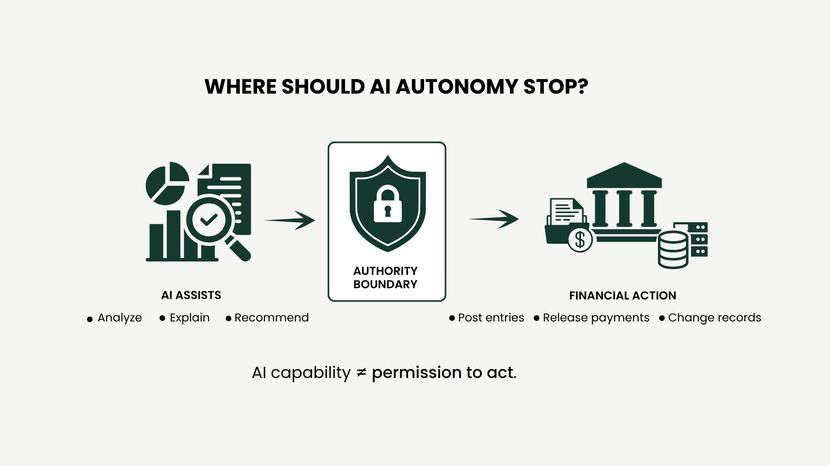
Drafting a variance explanation and posting an adjusting journal entry may draw on identical information, but only one changes the company’s records. A useful design principle separates information authority from transaction authority. Permission to read and interpret data should not imply permission to modify it.
Consider a possible duplicate payment. A copilot that surfaces the match and supporting records leaves judgment with an accounts payable specialist. A system that blocks the invoice on its own may disrupt a legitimate supplier payment. The nearer AI moves to changing records, moving funds or affecting outside parties, the stronger the controls must be.
Five Levels of Autonomy
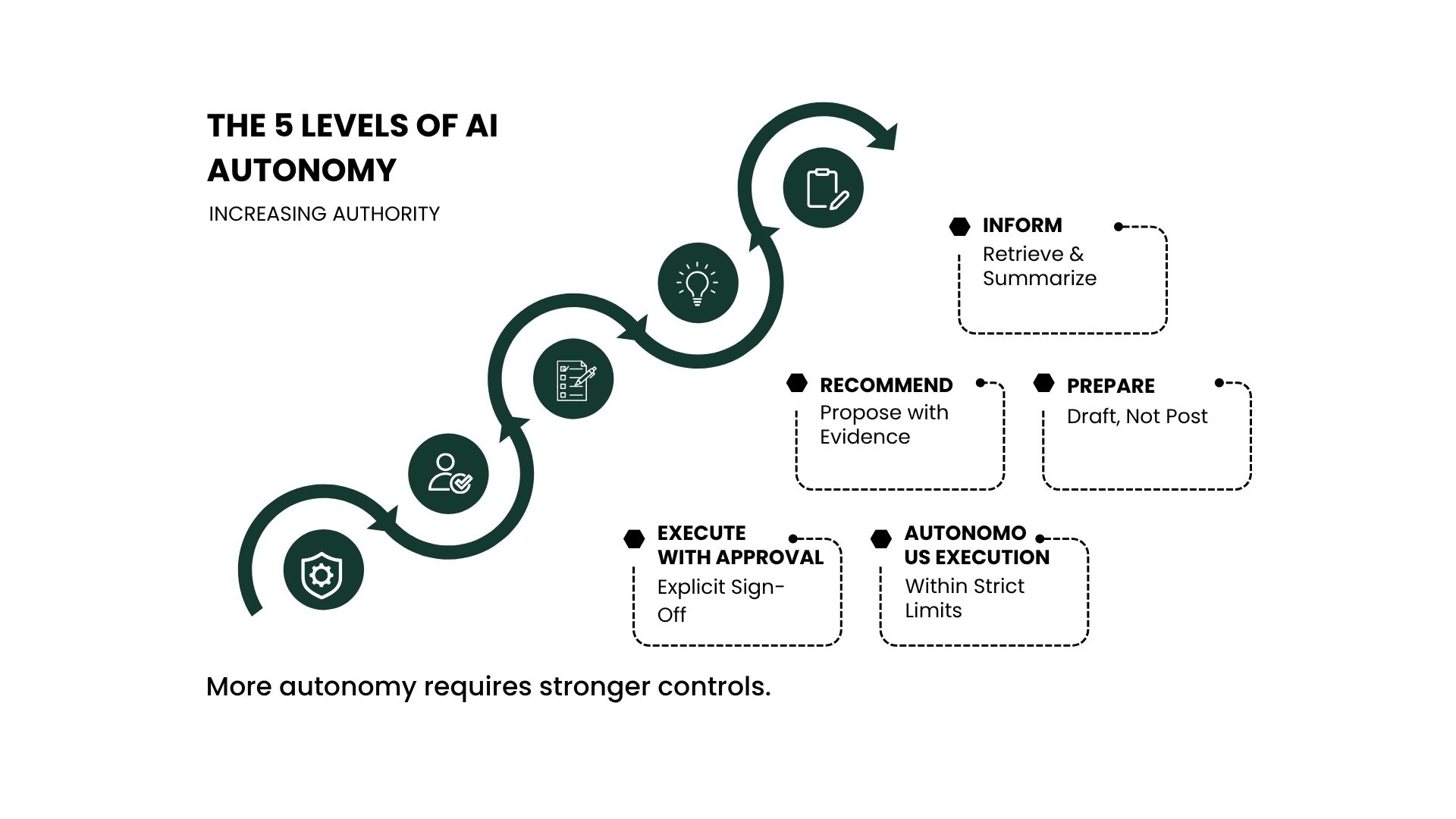
Many teams find it practical to place each process on a ladder:
- Inform: AI retrieves and summarizes information.
- Recommend: AI proposes an action with evidence, sources and stated uncertainty.
- Prepare: AI drafts a journal entry or payment batch, which stays unposted until an authorized person reviews it.
- Execute with approval: AI acts only after explicit sign-off, and the approved scope stays fixed. Changing amounts, accounts or recipients should trigger a new review.
- Autonomous execution: AI acts within narrow, pre-agreed limits, such as a value cap, defined vendor category and signed-off rules, with monitoring and recovery procedures.
This is an operating model, not a regulatory taxonomy. One department can legitimately use all five levels for different processes.
Choosing the Boundary
Technical capability should not set the level. Risk should. The main variables are financial materiality, reversibility, regulatory exposure, data sensitivity, predictability and the capacity of reviewers to check work meaningfully.
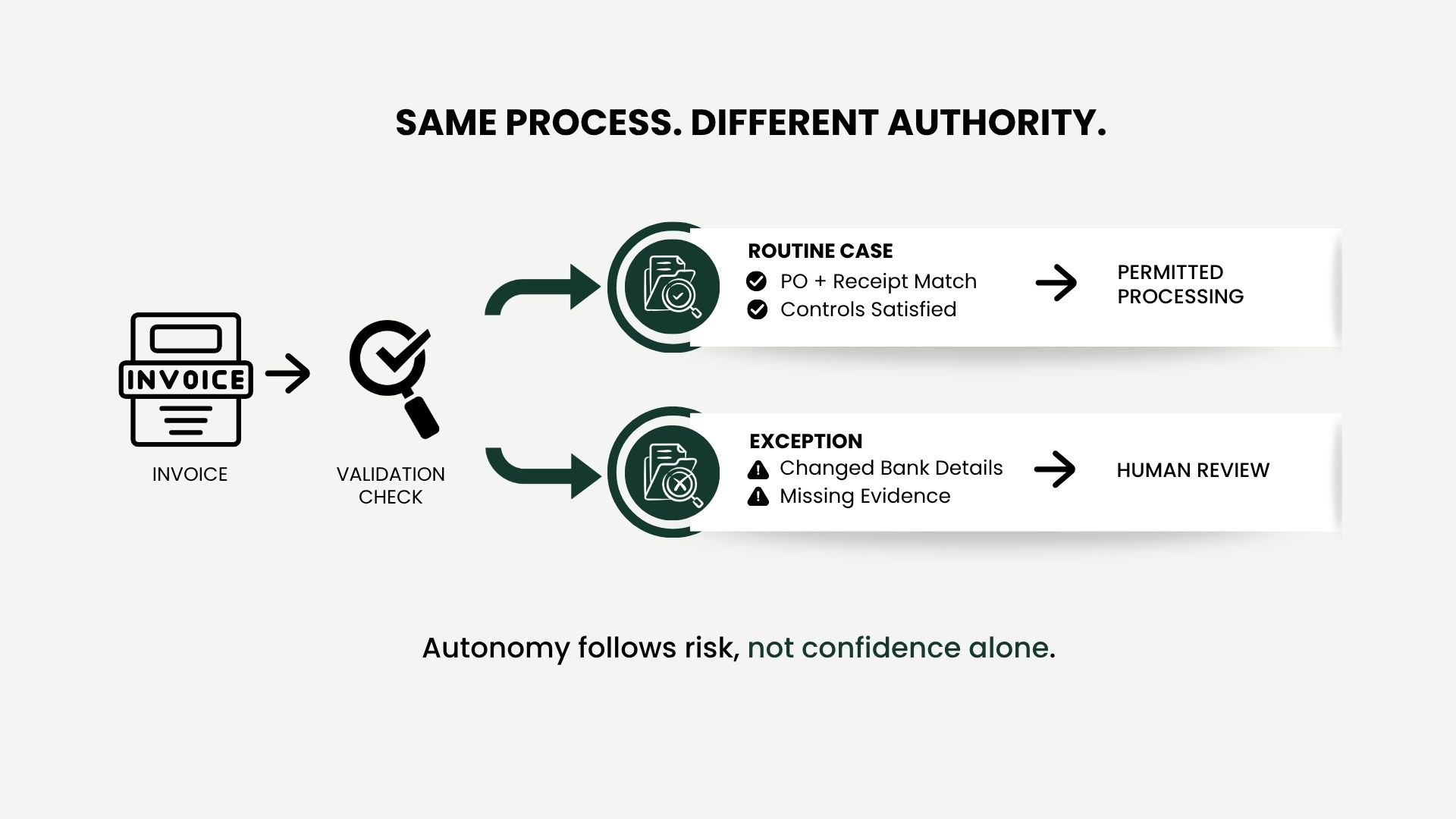
Three workflows show how this plays out. In FP&A, AI can generate scenarios and prepare proposed adjustments, while finance leadership approves the official forecast because it drives hiring, investment and liquidity decisions. In accounts payable, invoices that match approved purchase orders and receipts can flow with more autonomy, while changed bank details, unusual pricing or missing evidence go to an exception queue. In treasury, AI can model liquidity and prepare funding scenarios, but executing transfers warrants strict limits, segregation of duties and approval controls.
Autonomy therefore attaches to transaction characteristics, not to a department label.
Exceptions and Meaningful Oversight
Scalable copilots cannot rely on people reviewing every item, and they cannot treat every output as reliable. The workable model routes cases using rule validation, missing evidence, materiality and unusual behavior, not model confidence alone.
Confidence scores deserve skepticism. They should be calibrated against observed outcomes, because a model can be confidently wrong, especially on data unlike its training set. An invoice might score high on document extraction yet fail a deterministic supplier bank-account check. It should still escalate.
Oversight can also decay. If an approver sees hundreds of AI-prepared items daily, approval becomes rubber-stamping. Reviewers need enough evidence, time and authority to challenge a recommendation, and thresholds should be tested against historical data and revisited regularly.
Auditability and the Regulatory Picture
A defensible audit trail records which data version informed an output, which rules or calculations applied, which model produced it, whether a person changed it, who approved execution and what ultimately changed. Without it, investigating an unexpected payment or explaining a decision to internal audit becomes guesswork.
Several frameworks inform this work, with different standing:
- The NIST AI Risk Management Framework structures risk around Govern, Map, Measure and Manage. It is voluntary and not finance-specific.
- The US interagency supervisory guidance on model risk management stresses risk-based validation, effective challenge and ongoing monitoring. It applies to banking organizations, and its relevance to a given copilot depends on how the model is used.
- Under Annex III of the EU AI Act, systems that assess the creditworthiness of individuals or establish credit scores are classed as high-risk, subject to the Act’s provisions and exceptions, including one for fraud detection. That does not cover all finance automation, and an internal copilot summarizing a trial balance sits elsewhere on the risk map. Teams serving EU customers should confirm current requirements and timelines with counsel.
Established controls still matter. Segregation of duties, documented approvals and access restrictions apply whether an analyst or software prepares the entry. Neither COSO nor PCAOB standards were written for AI, so applying them to copilots involves interpretation that auditors should confirm.
Architecture and Measurement
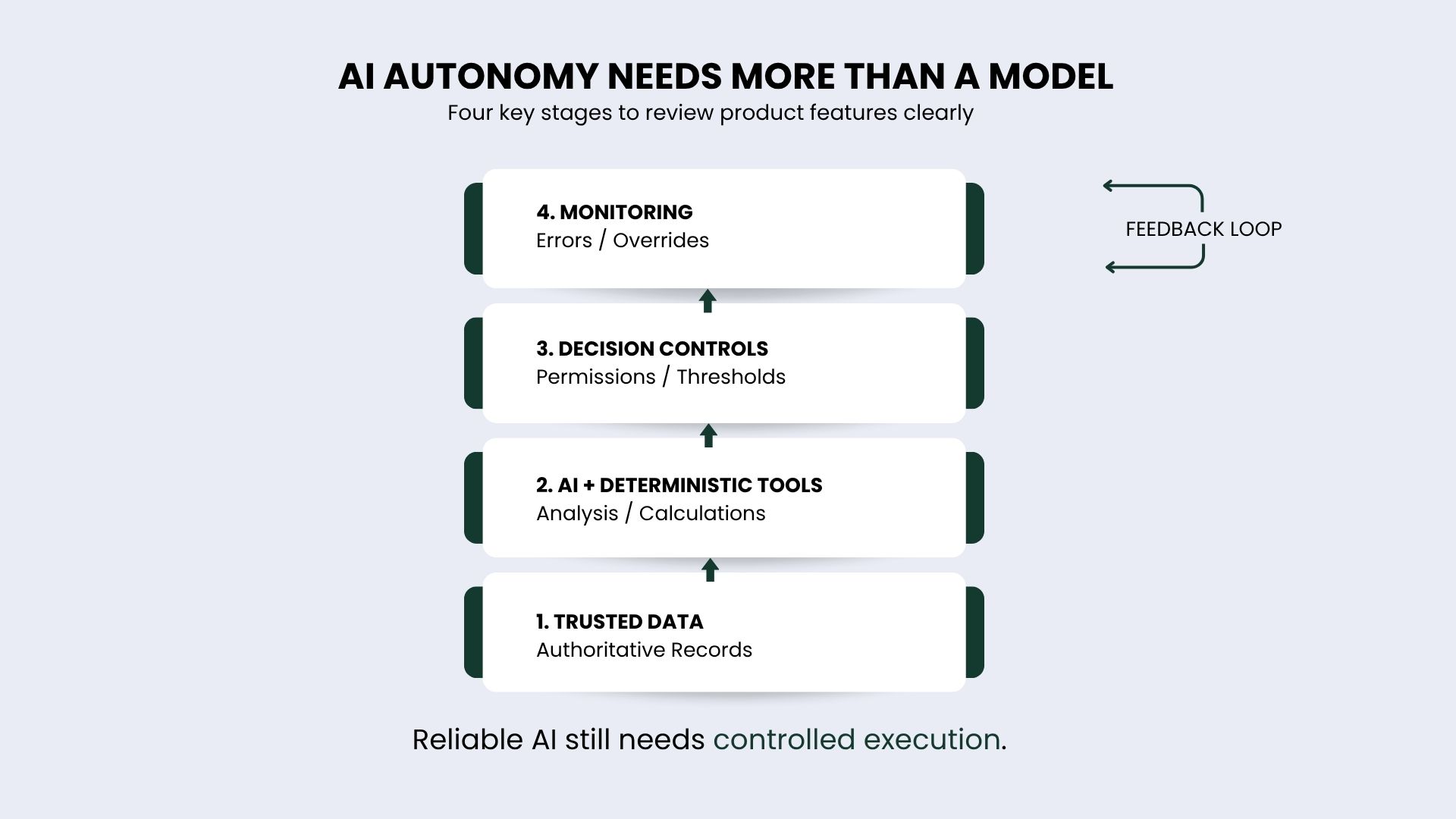
Four connected layers support this approach: a trusted data layer, an AI assistance layer paired with deterministic tools, a decision-control layer enforcing permissions, thresholds and exception routing, and a monitoring layer that tracks errors and overrides. They should be tested together, since a reliable model connected to unrestricted payment permissions is still an unsafe system.
Speed alone is a poor scorecard. Better indicators include exception accuracy, correction rates, review time, prevented unauthorized actions and the effort needed to investigate a decision.
Autonomy Should Follow Proven Control
The strongest copilot will not be the one that removes the most people from a process. It will reduce analytical effort while keeping authority, evidence and accountability clear. For finance and FinTech leaders, the design question is not how much autonomy the technology can support. It is how much the process can responsibly tolerate, and the answer should widen only as monitoring evidence accumulates.